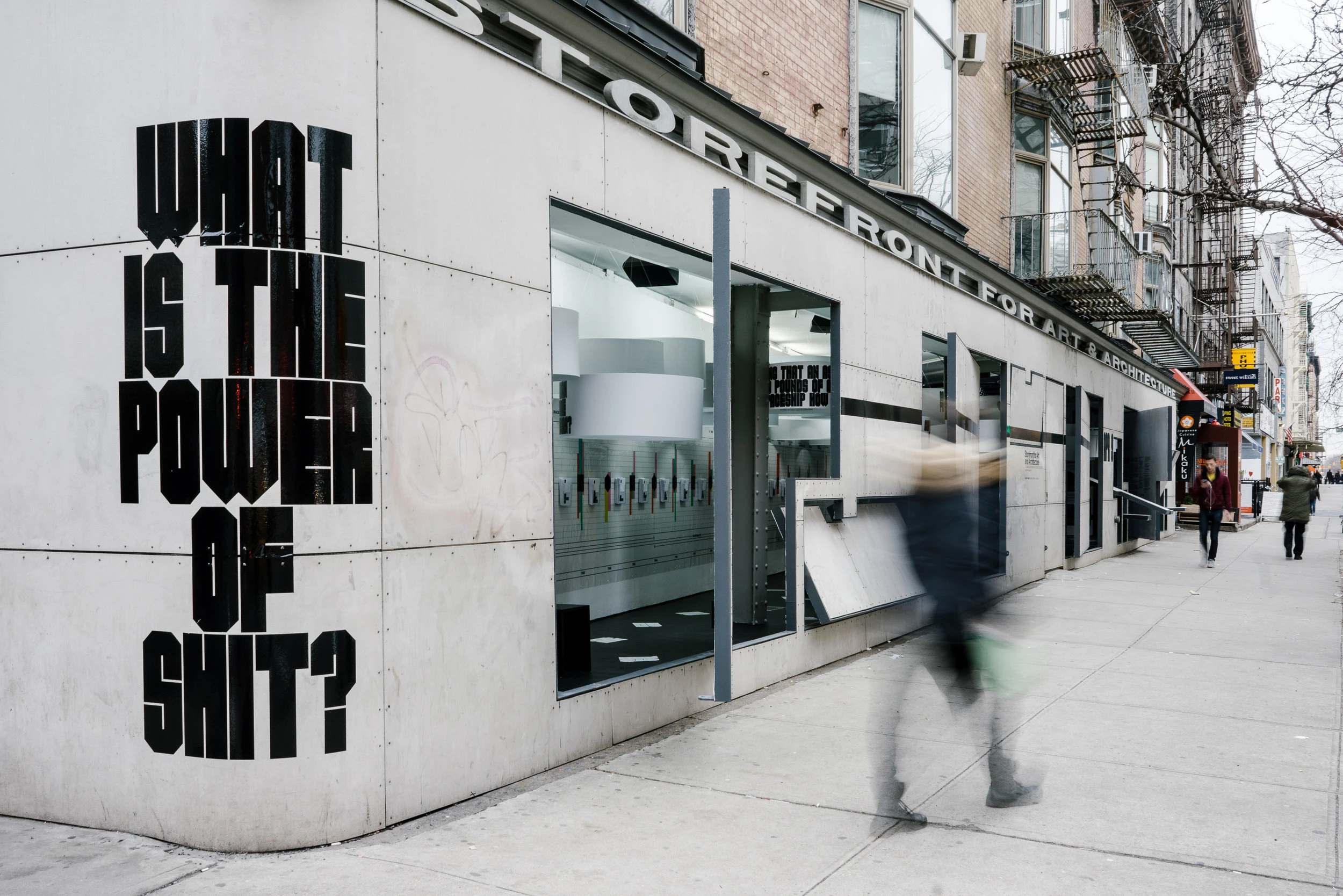
CLOSED WORLDS
An exhibition at the Storefront for Art & Architecture


What do outer space capsules, submarines, and office buildings have in common? Each was conceived as a closed system: a self-sustaining physical environment demarcated from its surroundings by a boundary that does not allow for the transfer of matter or energy.
The history of twentieth century architecture, design, and engineering has been strongly linked to the conceptualization and production of closed systems. As partial reconstructions of the world in time and in space, closed systems identify and secure the cycling of materials necessary for the sustenance of life. Contemporary discussions about global warming, recycling, and sustainability have emerged as direct conceptual constructs related to the study and analysis of closed systems.
From the space program to countercultural architectural groups experimenting with autonomous living, CLOSED WORLDS documents a larger disciplinary transformation and the rise of a new environmental consensus in the form of a synthetic naturalism, where the laws of nature and metabolism are displaced from the domain of wilderness to the domain of cities and buildings. While deriving from a deeply rooted fantasy of architecture producing nature, CLOSED WORLDS integrates these ideas into the very fabric of reality in our contemporary cities and buildings.
CLOSED WORLDS curated by Lydia Kallipoliti, exhibits an archive of 41 historical living prototypes from 1941 to the present that put forth an unexplored genealogy of closed resource regeneration systems. Prototypes are presented through unique discursive narratives with historical images, and each includes new analysis in the form of a feedback drawing that problematizes the language of environmental representation by illustrating loss, derailment, and the production of new substances and atmospheres. Each drawing displays a feedback loop, wherein man’s physiology of ingestion and excretion becomes the combustion device of an organizational system envisioned for humans, animals, and other live species. The moments of failure portrayed when closed worlds escape the designed loop cycles raise a series of questions about the ontology of autonomous enclosures.
The exhibition archive, designed by Pentagram, showcases a timeline of the 41 prototypes that illuminates the ways in which they have contributed to the idea of “net-zero” in our contemporary culture of sustainability. The timeline highlights the evolution of total circular resource regeneration from military research and the experiments of NASA’s space program, to more contemporary manifestations such as the benefits of the housing industry, countercultural practice for autonomous living in the city, nostalgia of the homesteading movement, and ecological tourism and environmental capitalism.
*This exhibition is dedicated to the memory of Michael-Angel Kallipolitis (1982-2016), who lived in a closed world and left ours too soon on January 5, 2016.
IN THE PRESS:
"Closed Worlds is one of the most thoughtful and challenging exhibitions in recent memory of the Storefront and worth leaving the sidewalk."
-"42 Closed Worlds," William Menking, The Architect's Newspaper
"An exhibition that guides visitors through a history of humanity's quest to find alternative and often greener ways to live."
"A Century of Wild and Utopian Experiments with Self-Sustaining Worlds"
Claire Voon, Hyperallergic
“The ingenuity of the exhibition lies precisely in its pointed definition of “Closed Worlds,” which allows Kallipoliti’s curatorial agenda to be all-inclusive and perhaps even exhaustive, without lacking specificity.”
“Expanding Closed Worlds”
Ivi Diamantopoulou, Suckerpunch Daily
"Closed Worlds explores how humans have sought to create synthetic Earth-like environments throughout the decades."
"The Strange, Messy History of Self-Sustaining Habitats"
Liz Stinson, Wired Magazine
"This Virtual Reality Installation Fools Your Lizard Brain"
Brady Dale, The Observer
Awards
ACSA annual award for Creative Achievement 2017