Eating and Being Eaten
The aim of this course was to reimagine planetary food systems, along with architecture’s expressive capacity to metabolize, digest and generate re-sources, as well as to decompose itself. During the COVID-19 pandemic, the question of ‘where our food comes from’ became eminently important. The fragility of our production processes and the mobility networks that transport commodities and food, urge new forms of localization and the design of circular economies. In this course, food was approached both literally, metaphorically, and in various scales: from the gut of our bodies to the ecology of territories and the technology of building systems.
In the first part of the course, the class assembled an archive of architecture and food systems; in other words, architecture that makes food or that is eaten away. Close readings and analysis of readings related to agricultural production, art, and culinary materialism were used as precedents and case studies. In the second part of the course, each student designed a plate and a space for that plate’s production and consumption with the objective to denaturalize edibility. Each menu was a feedback system, created in reflection of the plate and the space its production and consumption.



Vegetable Chowder by Sanjana Lahiri
This project is premised on companion planting, an idea that originated from the Indigenous Iroquois group. The Iroquois story of the Three Sisters spoke of how certain plants could be grown together to create a micro-ecosystem for mutual benefit. The first drawing depicts five plants grown using the companion method that form the ingredients to my dish: a vegetable chowder. The corn provides structure for the beans to grow, while the beans capture nitrogen from the air and release it into the soil for the other plants. Fallen leaves from the corn become green fertilizer for the potatoes. The potatoes repel the Mexican bean beetle, while the beans repel the Colorado potato beetle. Both the chives and the cilantro attract beneficial pollinators into the system. The corn, chives, cilantro, and beans have shallow root systems that don’t interfere with the growth of the potatoes. The second drawing shows the set-up for my dish, which is intended to be cooked as the ingredients are harvested. Edible stems and leaves are boiled to create vegetable stock. Potatoes, then beans, and subsequently herbs, are added to complete the soup. The dish employs the tools of the garden, the tools of the kitchen, and those of dining.
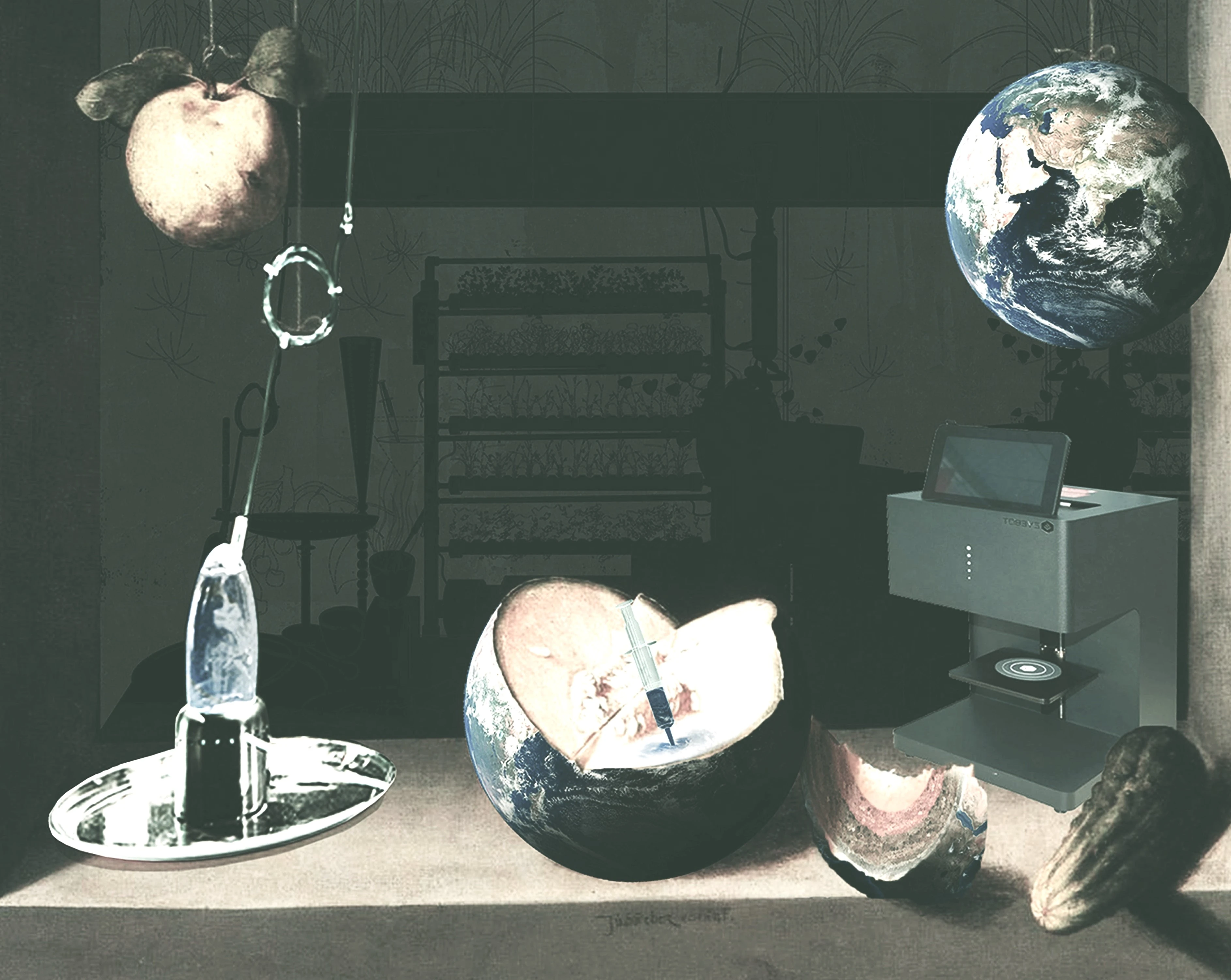
Synthetic Still-Lifes by Foivos Geralis
Since the early stages of western capitalism, food was associated with notions of territorial sovereignty, as depicted in Baroque still-life paintings, where excessive food compositions coexist with cartographies and models of globes. This coexistence reveals the artificiality of still-lifes as assembled food landscapes: collections of plants, fruits, lavish meat and sea-food, all from different seasons, environments and places of the world. At the intersection of the English term ‘still-life’, and the French ‘nature morte’ [dead nature] these paintings reveal the tense relation between the euphoric accumulation of extravagant food and capital, and the vanitas of withered leftovers, eloquent reminders of an inevitable gloomy future.
Today, similar synthetic and transglobal assemblages of collected elements can be found wherever food is sold. 18th and 19th-century selective cross-breeding of plants and cultivation technologies exponentially led to today’s hydroponics stacks, technologically-controlled environments, GMOs and new forms of food directly 3dprinted or grown in petri-dishes. Food exists now regardless of restrictions of place, climate or season.
By reconfiguring baroque still-lifes with contemporary iconography of food, cultivation environments (hydroponics, UV lighting, 3d-printers) and cartographic models, these drawings aim to bring into question the diachronic relation of the artificiality of food accumulation and its geopolitics, as well as the continuous processes of hybridization of food throughout the last centuries.
Fungal Futures by Sophie Krauss
Mycelium, the vegetative part of a fungus, helps sequester carbon in soil, and allows plants to exchange nutrients between species. Mycelium, as a carbon-free building material and a nutrient to recycle and compost plastic unfolds new potential for plant-based nourishment. Fungi may change the way we live, produce, and consume. The drawings depict a future where fungi become an essential part of domestic environments and daily life.
Therefore, the main component of my dish is the mushroom. It is not only as an ingredient on the plate, but also it becomes part together with rain, sun, and the human body of the life cycles within the house. Together with tomato and lettuce, the dish is grown and will decompose in the domestic environment. After digestion, it will produce heat and light for the vertical garden and coffee machine, which is essential for the oyster mushroom production. Every organism becomes part of a life cycle, and it participates in a cyclical process from matter to waste, back to matter.
The Chicken and the Egg by Annabella Chen
For my dish, I followed the journey of a single egg as it travels and transforms into the “Farm Egg” dish of the Manresa restaurant in California.
Long before the broiler chicken we now know, the first egg belonged to a dinosaur. Over the course of 200 million years, the contents of this egg evolved from dinosaurs into chickens, and in the past 50 years, into the specific morphology of our beloved modern-day, juicy, fat, engineered, broiler chicken.
In contrast to the high density, hyper-mechanized environments of factory farms, the chickens that bear Manresa’s eggs have access to sunlight and fresh air and ample space to roam. They embody a philosophy of respect for ingredients as materials that are not only defined by specific flavors, textures, and colors, but also by the labors of its production.
Once the egg enters the space of the restaurant, each element of the egg is taken and transformed with various tools and techniques to produce new textures and flavors, but the final dish bears great resemblance to its originary, a rich yellow yolk sitting in a pool of white, coddled by the hard shell of an egg.
Crafting the Image of Desire by Chau-Anh Nguyen
Unlike Salvador Dali’s flamboyant and grandiose lobster tower, the lobster dumpling stands quieter and more modest in size. They are almost each other’s opposite, even though both contain similar luxurious ingredients. While Dali’s lobster dish makes an overt attempt to showcase its hues: green olives, glossy brown rotisserie, orange carrots, and blood-red lobster shells, the lobster dumpling seems so covert. Its filling is perfectly concealed, barely visible from the translucent, shiny skin. The golden-brown broth, which the dumplings are submerged in, is clear and still. The chili oil, carefully pipetted on top, accents the stable, concentric arrangement of the dish. And finally, the thinly sliced scallion, picked up by tweezers, precisely lands on each dumpling’s peak.
The lobster dumpling dish is enigmatic, minimal, and abstract - a perfect representation of what is perceived as the new fine-dining aesthetic, or the new image of 21st century’s gustatory desire. Contemporary fine dining now relies less on the grandiose presentation, the excessiveness, or the origin story of the ingredients. Instead, using techniques such as “foreignizing” ingredients to transform the original textural and chemical state of the food, and composing dishes’ arrangement and food serving process with an extreme quantity of tools, fine dining reveals a strong desire for abstraction, detachment from the ingredients’ origins, and micro-precision in crafting its dish.
Chocolate by Ahzin Nam
Today the only link between the source of food and the consumer are the white pristine characters on the back of food packaging. The shape-shifting ability of processed food, with its “recipes” allowing the final products’ form to be independent of material characteristic of original ingredients, become a method to erase bridges between the producers and consumers of food. Drying, mixing, blending, coating, stacking, bundling, and casing become a process centered around inventing new forms of mass production and distribution. The real narrative of industrial farming and exploitation of labor and resources become hidden by casting the material into a seemingly innocent flattened sphere, masked by a face from an imaginary narrative.
The dish is hidden among the piles of m&m in your regular convenience stores. Instead of colorful round beads, the package contains items on the ingredients list in their granular form. On each individual package, there is a barcode that connects the customer to the location where each ingredient is produced. Every time you scan the barcode, it teleports you to the location, telling you the cost of labor, nature, and the future you are about to consume. The dish attempts to rebuild the broken bridge, providing a glimpse to the pieces of places in our stomach.
Cold-Fashioned by Xinyi Guo
The dish presents itself as a drink and shifts the focus to America, who was first established as a British colony. The evolution of flavors in the cup tells the story of its colonial history. Breaking free from the colonial cup, this cocktail uses ingredients of historical significance that are locally harvested and mark the independency of the country. “Cold Fashioned” is primarily the mix of 1 oz of Kentucky Bourbon and 1 oz of Arbuckle Coffee, garnished with orange peels. The national quality of the drink comes from the history of the two major ingredients.
Until the mid-1760s when American Revolution broke out, the colonial’s favorite alcohol has always been rum, introduced by the British, rather than whiskey. A boycott of British goods prompted the colonist to invest in distilling a uniquely American drink. The Kentucky Bourbon, also called the American Whiskey, eventually came out of this investigation. Within a few years, colonists in the east began their own whiskey production using barley and rye. Soon afterwards, whiskey consumption surpassed that of rum and in 1964, the United States Congress recognized Bourbon as a distinctive product of the United States.
Not unlike Kentucky Bourbon, the consumption of coffee in United States started as way of showing patriotic duty. Coffee plants reached the New World in the early 18th century yet remained unpopular until the Boston Tea Party incident in 1773 when the Americans made their switch from tea to coffee. A sudden growth demand for the drink encourages the expansion in coffee bean plantation as well as explorations in roasting and packaging. The Arbuckle coffee was first started in the post war period, initiated a new concept in the coffee industry by selling roasted coffee in one-pound bags, which transformed coffee into an enjoyable and accessible drink to the American public.
As a mix of these two distinctive tastes that cannot be imported, “Cold Fashioned” signified pleasure and pride in America’s national identity and critiques the colonization and reformation of indigenous territories.