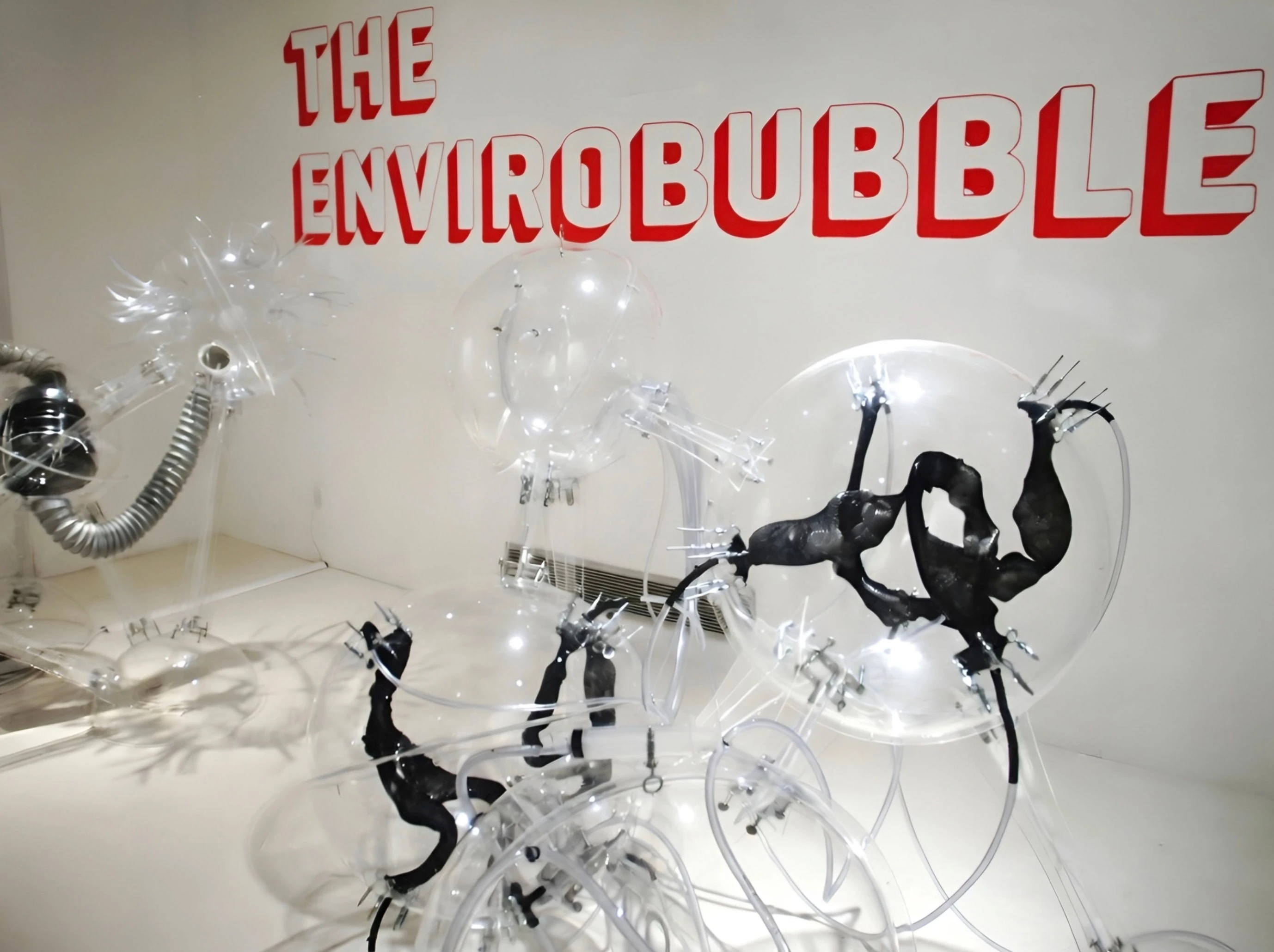
The ENVIROBUBBLE revisits Reyner Banham's concept of the Environmental Bubble as a plug-in infrastructure for HVAC systems. Building technologies typically relegated to engineering—filtration, ventilation, humidity control, and air circulation—are reimagined as architectural and spatial design tools for remediating indoor air quality.
The project questions whether interior environments are healthier than exterior ones, drawing attention to the invisible pollutants that accumulate within tightly sealed, mechanically conditioned buildings. By shifting the conversation from outdoor pollution to the atmospheric conditions of enclosed spaces, the ENVIROBUBBLE exposes the environmental consequences of contemporary climate-controlled interiors.
The installation consists of four clusters of air pods that function simultaneously as purification devices and instruments of visualization. Each cluster addresses a distinct atmospheric condition: dust (particulate inorganic matter), moisture (humidity and condensation), toxic gases (volatile organic compounds released through off-gassing VOCs), and carbon dioxide (air quality shaped by respiration and occupancy). Together, the pods reveal the invisible dynamics of indoor atmospheres while actively transforming them.
By framing indoor air quality as an architectural design problem rather than an engineering problem, the ENVIROBUBBLE proposes a new vocabulary for environmental control—one in which buildings become active participants in sensing, visualizing, and metabolizing the air they contain.
Moisture Pod: The Moisture Pod harvests humidity from the air, condensing water vapor through a network of interconnected tubes and collecting it for reuse. Conceived as a prototype for an architectural dehumidification system, it improves indoor air quality while generating reclaimed water for irrigation and other non-potable household uses.
Dust Pod: At the domestic scale, dust contains small amounts of human and animal hairs and shed skin particles, plant pollen, textile and paper fibers, soil minerals from outdoor soil, and other matter found in the local environment. The Dust Pod captures airborne particulate matter through electrostatic ionization. As dust accumulates on a suspended network of conductive threads, it gradually forms a dense insulating surface. The project reimagines dust collection as both an air purification strategy and a means of producing new material from atmospheric residue.
CO₂ Pod: The CO₂ Pod uses plants as a living filtration system. By coupling human respiration with plant photosynthesis, it creates a dynamic exchange in which carbon dioxide is absorbed and oxygen is released. Pneumatically controlled chambers expand and contract the planted surface, transforming the installation into a breathing architectural lung.
Gas Pod: The Gas Pod addresses volatile organic compounds (VOCs)—colorless gases emitted by synthetic materials that often accumulate indoors at concentrations far exceeding those outdoors. Air passes through a sequence of filtering chambers that progressively remove contaminants before re-entering the room. The layered filtration system also suggests a new type of building envelope, where environmental performance and spatial expression become one.
See “The Envirobubble” publication at S.L.U.M Lab newspaper (Spring 2011) here