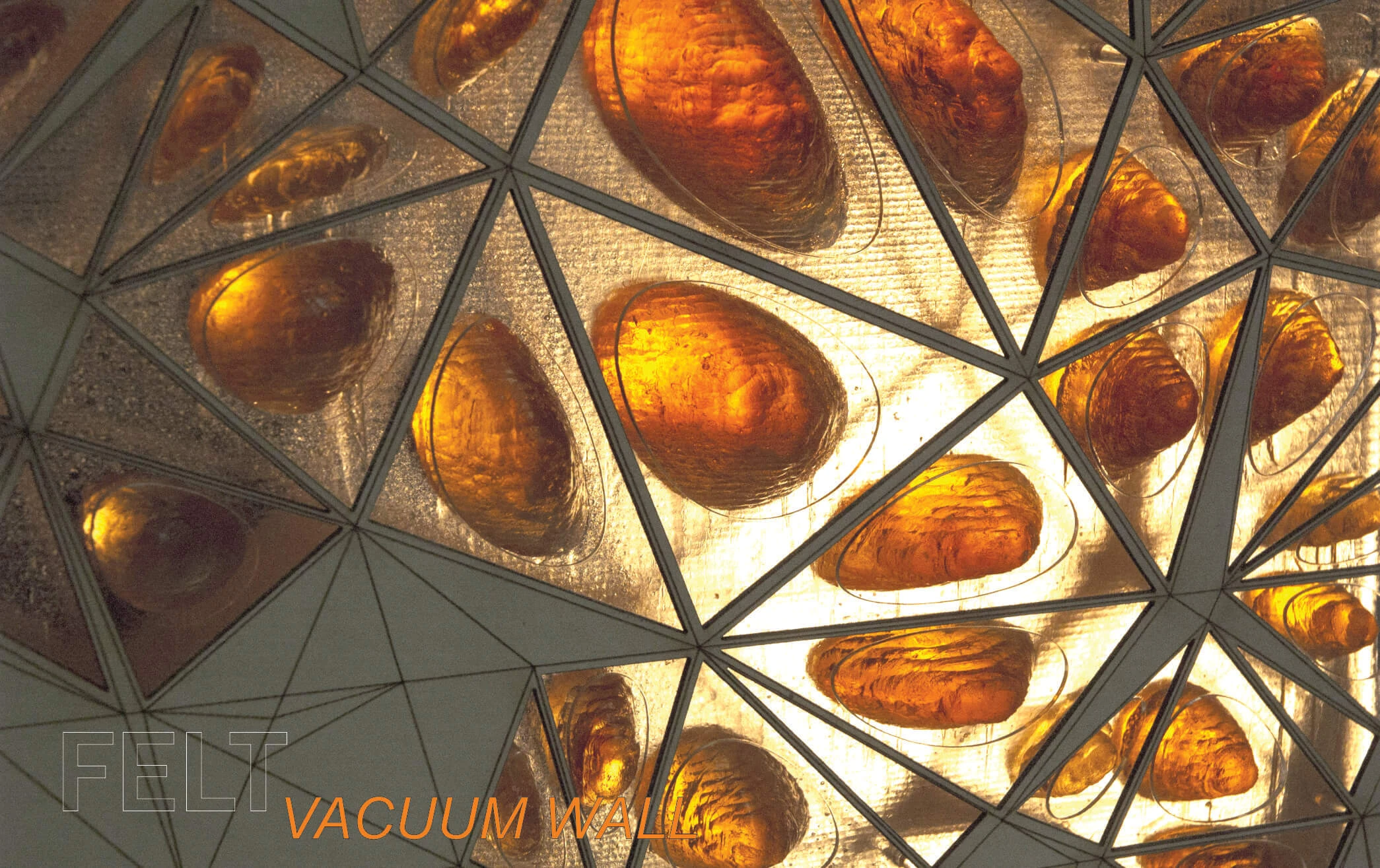
Felt Vacuum Wall
Prototype for a building envelope as an Archive of atmospheric Dust


Felt Vacuum Wall reimagines the building envelope as an atmospheric filter that actively transforms airborne pollution into architectural material. Conceived for dense, polluted cities, the project embeds a dust-collecting device within the exterior wall, enabling the façade to purify the air by absorbing suspended particulate matter. Rather than remaining a passive boundary between inside and outside, the wall becomes an environmental interface whose own contamination is productive, converting pollutants into a resource.
The system employs electrically charged felt to attract and retain airborne dust. Like a magnet drawing iron filings, electrostatic forces channel fine particles onto the felt surface, where they gradually accumulate and become embedded within the material. Felt is itself a material defined by accretion: a non-woven fabric whose irregular fibers continuously bind with additional matter. Here, that natural process is accelerated through electricity generated by piezoelectric elements integrated into the façade. Wind-induced movement within the building envelope provides the mechanical stress required to generate this electrical charge, allowing the wall to harvest energy from its environment while simultaneously collecting pollution.
The façade consists of two translucent exterior layers enclosing a folded membrane of felt. Pneumatically actuated pockets enable the felt to expand through calibrated openings in the envelope, increasing its exposed surface area and regulating its interaction with surrounding air currents. As dust accumulates over time, the felt thickens, darkens, and acquires new physical properties, making visible the environmental conditions to which the building is exposed. Pollution is no longer hidden or displaced but registered directly onto the architecture itself.
Once saturated, the felt membrane can be removed and repurposed as a moisture barrier in building foundations, extending the material's life beyond its initial environmental function. Rather than treating pollution as waste to be discarded, Felt Vacuum Wall proposes an architecture of accumulation, in which atmospheric contaminants become agents of material formation. The project imagines the façade not as a finished object, but as a living surface that continuously exchanges matter with the atmosphere and transforms environmental liabilities into new architectural resources.