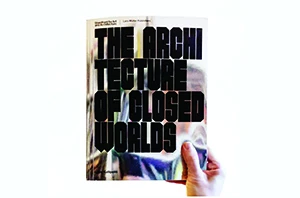
The Architecture of Closed Worlds, Or, What is the Power of Shit
The Architecture of Closed Worlds, Or, What is the Power of Shit


What do space capsules, submarines, and office buildings have in common? Each was conceived as a closed system: a self-sustaining physical environment demarcated from its surroundings by a boundary that does not allow for the transfer of matter or energy.
The history of twentieth-century architecture, design, and engineering has been strongly linked to the conceptualization and production of closed systems. As partial reconstructions of the world in time and in space, closed systems identify and secure the cycling of materials necessary for the sustenance of life. Contemporary discussions about global warming, recycling, and sustainability have emerged as direct conceptual constructs related to the study and analysis of closed systems.
From the space program to countercultural architectural groups experimenting with autonomous living, Closed Worlds documents a disciplinary transformation and the rise of a new environmental consensus in the form of a synthetic naturalism, wherein the laws of nature and metabolism are displaced from the domain of wilderness to the domain of cities and buildings. While these ideas derive from a deeply rooted fantasy of architecture producing nature, Closed Worlds displays their integration into the very fabric of reality in our contemporary cities and buildings.
Closed Worlds presents an archive of 39 historical living prototypes from 1929 to the present that put forth an unexplored genealogy of closed resource regeneration systems. Prototypes are presented through unique discursive narratives accompanied by historical images, and each includes new analysis in the form of a feedback drawing that problematizes the language of environmental representation by illustrating loss, derailment, and the production of new substances and atmospheres. Each drawing displays a feedback loop, wherein the human physiology of ingestion and excretion becomes the combustion device of an organizational system envisioned for humans, animals, and other live species. The moments of failure portrayed when closed worlds escape the designed loop cycles raise a series of questions about the ontology of autonomous enclosures.
The book also showcases a timeline of the 39 prototypes, illuminating the ways in which they have contributed to the idea of “net zero” in our contemporary culture of sustainability. The timeline highlights the evolution of total circular resource regeneration, from military research and the experiments of NASA’s space program, to more contemporary manifestations such as the benefits of the housing industry, countercultural practice for autonomous living in the city, nostalgia for the homesteading movement, and ecological tourism and environmental capitalism.
This book examines ecological questions viscerally, via the raw ecology of our bodies and their excrement. It studies recycling not as a statistical problem relayed to the management of urban resources but as a basic bodily reality affecting the water we consume and the air we breathe. To write a counter-history to the established sustainability axiom “cradle to cradle,” one needs to look at shit. Only through this raw confrontation may the ecology of life be somehow useful. To avoid clichés of sustainability, shit might be our only way out.