THE METABOLIC HOME
A Prototype for new forms of co-habitation and decarbonization in dense cities
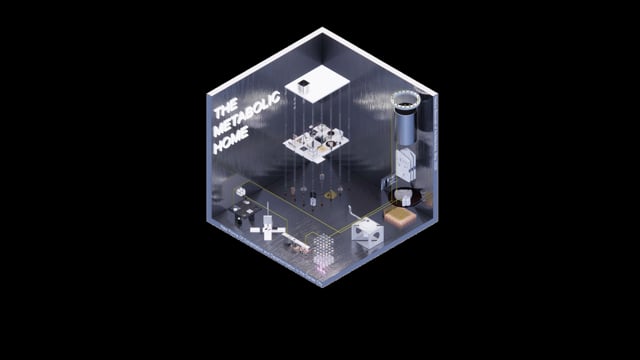


The Metabolic Home presents an archetypal program of inhabiting the Greek city, conceived as a living experiment and stage set where humans and other species, and their physiology of ingestion, occupation, and excretion, become combustion devices and integral components of co-habitation. Conceived as a digestive system, the home receives human output in its many forms and transforms it into resources, materials, food, and energy. The project understands resources through the visceral ecologies of the body. Climate justice is not an abstract statistical problem but one that lands on bodies—through the food we eat, the water we drink, and the air we breathe. The household becomes both a microcosm of planetary systems and a test bed for new forms of resource recirculation and everyday decarbonization.
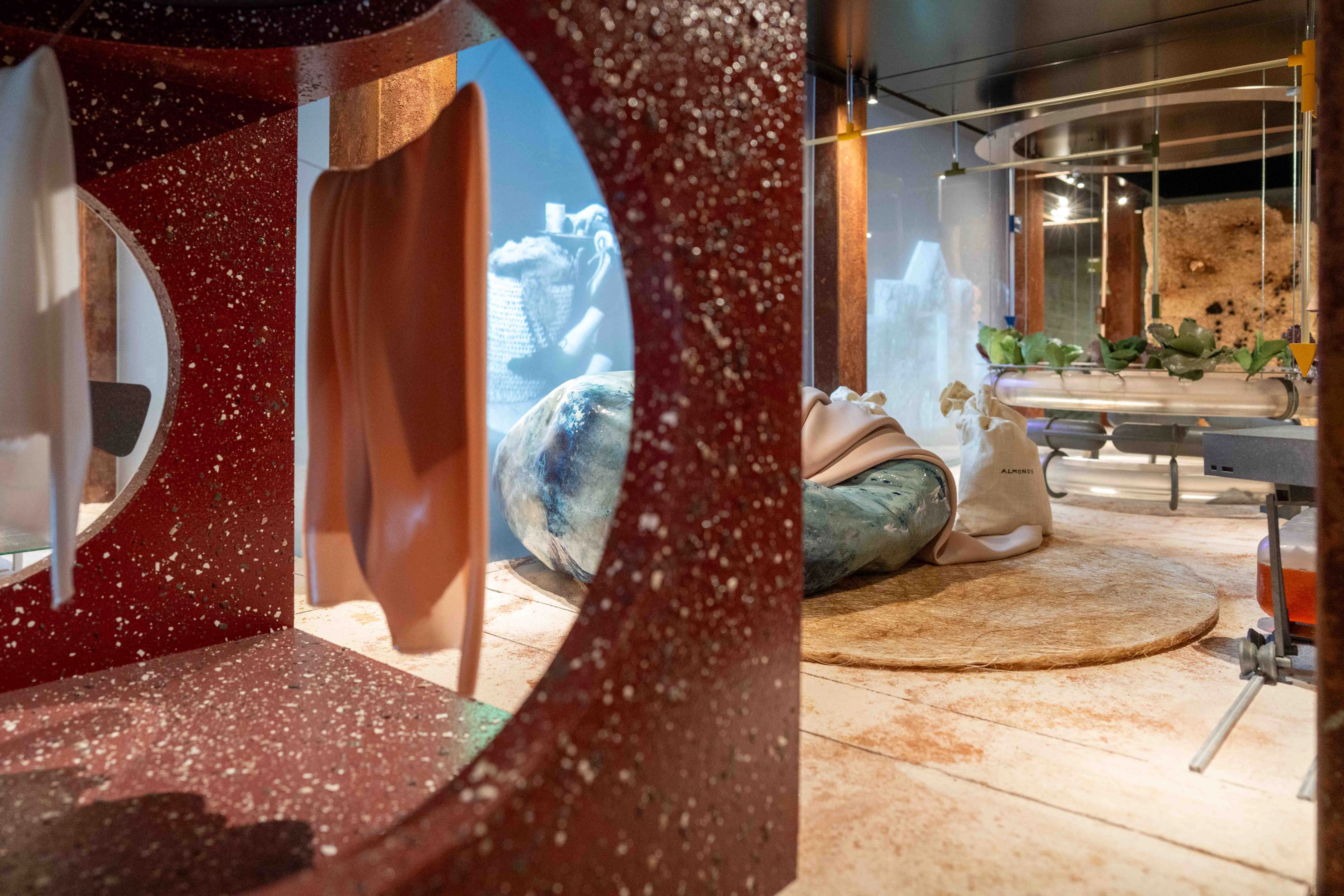
The installation is a 1:5 scale model of a home featuring ten domestic spaces—kitchen, toilet, lounge, bedroom, laundry, storage, garage, garden, balcony, and light well—each revealing how metabolic processes intertwine with daily domestic activities. Every part of the home is interconnected, transforming “waste” from one space into a resource for another. For example, kitchen greywater and organic waste nourish hydroponic food production in the garden, while, AI regulates the laundry’s microclimate, channelling moist and cool air through the light shaft, which also serves as a site for domestic mycelium cultivation. Household objects are produced from the outputs of human and other living species, linked to specific rooms. Kitchen furniture is formed from biochar bricks made from the space’s own organic waste; a pollinator wall on the balcony is constructed from mycelium blocks harvested from the light well and processed in the storage; and biofuel is generated in the garage from decomposed food waste.
The aged building stock of Greek cities, typically made of cement and reinforced concrete, is reaching the limit of its lifespan and is in dire need of retrofit. One objective in this proposal is to claim a gradual replacement of typical building blocks, piece by piece, while also suggesting that decentralizing energy and resource distribution may transform environments and power relations. Rather than relying on centralized infrastructures, the project proposes localized federated networks of energy and resource production, suggesting that decentralizing environmental services can reshape both urban environments and power relations.
As a starting point, we use the reconstruction of the household as a living experiment that recirculates its waste and regenerates its resources. The logic of material conversions generates new spatial alliances between a toilet and a garden; a bioreactor and a bathroom; a kitchen and a balcony; a laundry room and a shaft; a light well and a lounge. The metabolic processes create new domestic typologies and programmatic alliances, while intelligence is reimagined as material constellations—enabling new forms of cohabitation and decarbonization in the dense city.
Converting the output of one domestic space into the input of another moves beyond the familiar discourse of circularity toward ecological redundancy, overlapping temporalities, and parallel metabolisms. Overall, The Metabolic Home cultivates the coexistence of many metabolic orbits. Architecture does not close all loops into a unified whole; it provides the conditions under which multiple metabolisms overlap, exchange matter, and continually reorganize themselves.
European Design Awards
Gold Medal in Exhibition and Spatial Design 2026

Shortlisted in the World Architecture Festival (WAF) Interior Awards 2026